A First Game from the Stands: What to Watch Between Shots
At your first live basketball game, learn to read cuts, screens, and defensive matchups so the action between shots makes sense without chasing the ball.
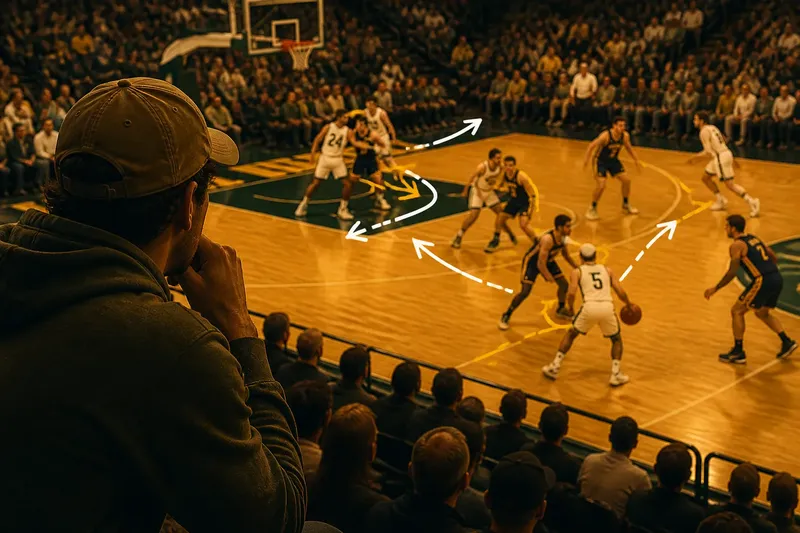
The most common mistake at a first live basketball game is following every pass and looking only at the ball. That makes it easy to miss the screen that delays a defender or the cut that draws help away from the basket. Watch the space around one action instead, and the next opening becomes easier to understand.
What should you watch when a player cuts?
A cut is a quick move toward the basket or into open space. Look for a player changing direction just as their defender turns toward the ball, steps toward a teammate, or loses sight of them.
The cut matters even when the player never gets a pass. If a defender follows, someone else may have more room. If a second defender leaves their assignment to stop the cutter, notice which attacker is now less closely guarded.
Follow the cutter’s route after the move, too. They may continue through the lane, pause near the basket, or return to the perimeter. That next choice helps explain where a passing option may appear.
How can you read a screen in the action?
A screen is a position an offensive player takes to impede a defender’s path. Watch for a teammate moving close to the ballhandler’s defender, then follow what both the defender and the ballhandler do.
The ballhandler might go around the screen, move the other way, or pass before using it. The screener may then move toward the basket or step back into open space. Each movement gives the defense another assignment to handle.
Screens can also happen away from the ball. On the weak side—the side away from the ball—look for two attackers crossing close together. If a defender is delayed, check whether the other attacker has gained room to move or receive a pass.
What changes when defenders switch assignments?
Choose one matchup to follow through a screen or crossing movement. Does the defender stay with the same attacker, or does another defender take over? The answer tells you what changed without requiring you to name a defensive system.
Some defenses switch, with defenders trading the attackers they guard. Others try to stay with their original assignments or briefly help before recovering. Watch who ends up responsible for whom, and whether an attacker has a moment of extra space.
Imagine a guard follows a cutter around a screen while a taller defender picks up the ballhandler. The starting point is the guard defending the cutter; the action is the exchange; the observable result is a new matchup. Next, look at the screener: if nobody picks them up as they move toward the basket, that space may become a passing option. If a defender does cover them, note which other attacker is left open instead.
Where should your eyes go when a defender helps?
When an attacker drives toward a crowded area, a defender may leave their assignment to help. Rather than trying to track every player, notice who the helper leaves and whether another defender shifts over to cover that attacker.
If the ball moves quickly to the open player, defenders may need to recover across the floor. If it does not, the original defender may return. Either way, the useful clue is how the help changes the space available elsewhere.
For a clearer view, follow the attacker who was left open. See whether the gap closes, stays open, or prompts another defender to move. That sequence makes the rotation visible without requiring you to predict what the offense will do.
What can you learn from the rebound action?
As a shot goes up, look beyond the shooter. Some players turn to find an opponent; others move toward the basket or toward the edges, where a rebound may go.
On a miss, notice whether a defender places their body between an opponent and the ball, a move called boxing out, or whether an attacker gets around them to pursue the rebound. On a make, watch how both teams turn toward the next possession.
This is also a useful moment to notice players who were away from the original action. One may try to stop an opponent from reaching a loose ball while another contests near the basket. Their choices depend on the play, so avoid assuming a role from one moment.
What do viewers ask about off-ball movement?
How can I tell whether a player is cutting?
Look for a sudden move toward the basket or into open space, especially as the defender turns toward the ball. The movement can matter even if the cutter does not receive a pass.
What does it mean when defenders switch?
Two defenders have traded the attackers they guard, often after a screen or crossing movement. Follow the new assignments to see whether anyone has gained space.
Where should I look during a shot?
Watch players near the basket and defenders finding opponents, then glance toward the perimeter for movement toward a possible rebound. The shooter is only one part of the action.
What if I lose track of the play?
Use the next possession to follow one matchup, such as the ballhandler and their defender. When a screen or cut changes that pairing, check who takes over.
How can you keep track without missing the game?
Let the ball take your attention when the play is moving quickly, then use pauses—such as a free throw or a timeout—to reset your view. After play resumes, look for one specific event: a screen, a cut, a defensive switch, or a player boxing out. This keeps your attention on a concrete action rather than asking you to monitor every matchup at once.
Say you see a player near the weak-side corner while a teammate sets a screen nearby. The starting point is the corner player and their defender; follow the defender as the screen arrives, then check whether the corner player has room or whether another defender takes over. If the view is blocked, shift your attention to the ballhandler’s defender on the next possession instead. Either outcome gives you a clear next thing to watch.
It is not worth trying to name every defensive scheme from a single possession. Similar movements can have different causes, and a brief view may not show the whole exchange. For your first live basketball game, focus on one screen, cut, or defensive response at a time; noticing the change in space is often enough to make the action between shots easier to follow.